
A child arriving at out of school care at 3:30 has already done six and a half hours of sitting still, following instruction, negotiating a playground, and holding themselves together. They are, in the most literal sense, spent.
The temptation for a program is to fill that time productively. Structured activities, a homework block, an enrichment theme. It looks impressive on a schedule and it is largely the wrong idea.
The first thirty minutes should be nearly empty
The most valuable thing we offer between 3:30 and 4:00 is the right to be left alone. Food is not provided for out-of-school care — please pack what your child needs.
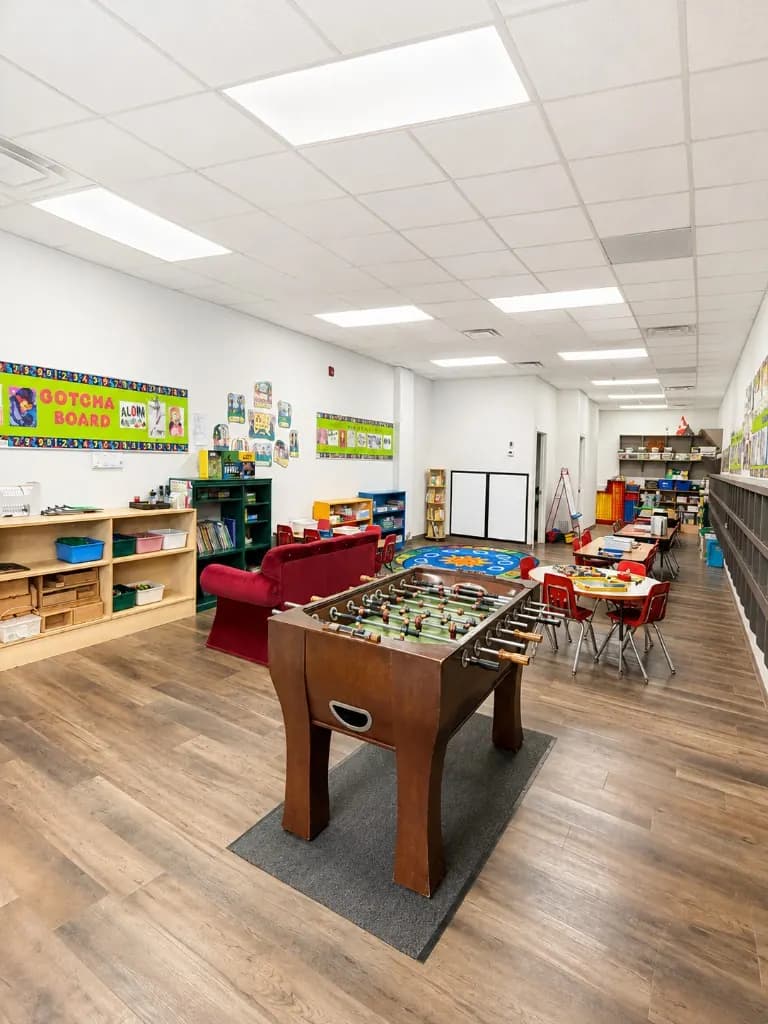
Genuine free choice — the foosball table, a book, drawing, lying on the floor doing nothing, or three children in a corner conducting an elaborate ongoing negotiation about a game they invented in October. No adult agenda.
This is not us being lazy. Decompression is a developmental need at this age, and unstructured time with peers is where school-age children do their actual social learning. Anything an adult organises for them, no matter how good, replaces something they were doing for themselves.
Homework: available, not compulsory
We have a quiet table, a jar of sharpened pencils, and an educator who will help. Children who want to get their reading log done before they go home can, and many do, because they would rather not do it at 7 PM.
What we do not do is make it a mandatory block. Homework is between a child, their teacher, and their family, and a centre that enforces it puts itself in the middle of a relationship it is not part of. If you would like us to nudge your child, tell us and we will nudge. That is a conversation with you, not a policy.
The mixed-age thing is a feature
Out of school care spans grade one to grade six, which sounds like a supervision problem and is mostly an advantage.
A grade five child explaining a card game to a grade one child is doing something a same-age classroom cannot easily offer. The older child practises patience and clear explanation; the younger one gets a model who is close enough to be credible. We see it every afternoon and it consistently produces better behaviour than age-segregated groups do.
It does need managing. Older children get space and materials that are actually theirs, because a ten-year-old who feels they are in a room designed for six-year-olds will disengage entirely.
Getting there safely
Children are walked or transported from school in the daycare van. One thing worth stating plainly, because it is in the registration package and easy to skim past: once a child is on school premises they are in the school's care, not ours. The handover point matters, and knowing exactly where it sits protects everybody.
We take attendance at the school, in the van, and at the door. If a child is not where they should be, we know within minutes, and we call you.
What good looks like by 6 PM
If you collect your child and they are calm, mildly grubby, mid-sentence about something that happened, and reluctant to leave — that is the program working.
If they are wired, over-stimulated, and melting down in the car park, something in the afternoon was too busy. That is feedback we want.
Details on ages, schools we collect from, and schedules are on the out of school care page. Kindergarten wrap-around care works differently and is covered on the kindergarten page.