Parents sometimes watch outdoor time and go slightly pale. A four-year-old is at the top of the climber, unassisted, and no adult is holding them.
That is deliberate, and there is a distinction underneath it that is worth borrowing.
Risk versus hazard
A hazard is a danger the child cannot see and could not reasonably assess: a broken rung, a protruding bolt, a gate that does not latch, a scarf that could catch. Hazards are our job. We remove them, we check daily, and children are never asked to manage them.
A risk is a challenge the child can see and can judge: this branch is high, this log is wobbly, this jump is further than the last one. Risk is the material of development, and removing it removes the learning.
Our job is to eliminate hazards so children can practise on risks.
What risk teaches
A child at the top of a climber is running a real calculation — how high, how stable, what my body can do, whether I can get down. Getting that calculation right requires having got it slightly wrong a few times, at low stakes, with a graze rather than a fracture.
The alternative is a ten-year-old with no calibration at all, meeting a genuinely risky situation for the first time with no experience to draw on. That is the outcome risk-averse childhoods actually produce.
There is also a straightforward confidence effect. A child who has climbed something difficult knows something about themselves that no amount of praise can install.
What we actually do
- Daily hazard checks on equipment, surfaces, fencing, and gates before children go out.
- Educators positioned, not attached. Close enough to intervene, far enough that the child is doing the judging.
- We narrate instead of rescuing. "Where will your foot go next?" rather than lifting them down. Lifting a child down teaches them that they cannot do it.
- We let them get themselves down. Going up is the easy half. Coming down is where the learning is.
- We do not say "be careful." It is too vague to act on. "Hold with both hands" or "that branch is thin" gives a child something to actually do.
- Hard limits exist. No pushing, nothing thrown from height, nothing near the gate. Those are not negotiable.
What this means for grazes
Your child will come home with scrapes sometimes. We will always tell you what happened and we log anything beyond a minor bump.
A centre where no child ever grazes a knee is a centre where children are not moving enough, and the trade for that is worse gross motor development, worse balance, and less confidence. We think the scrapes are the better deal.
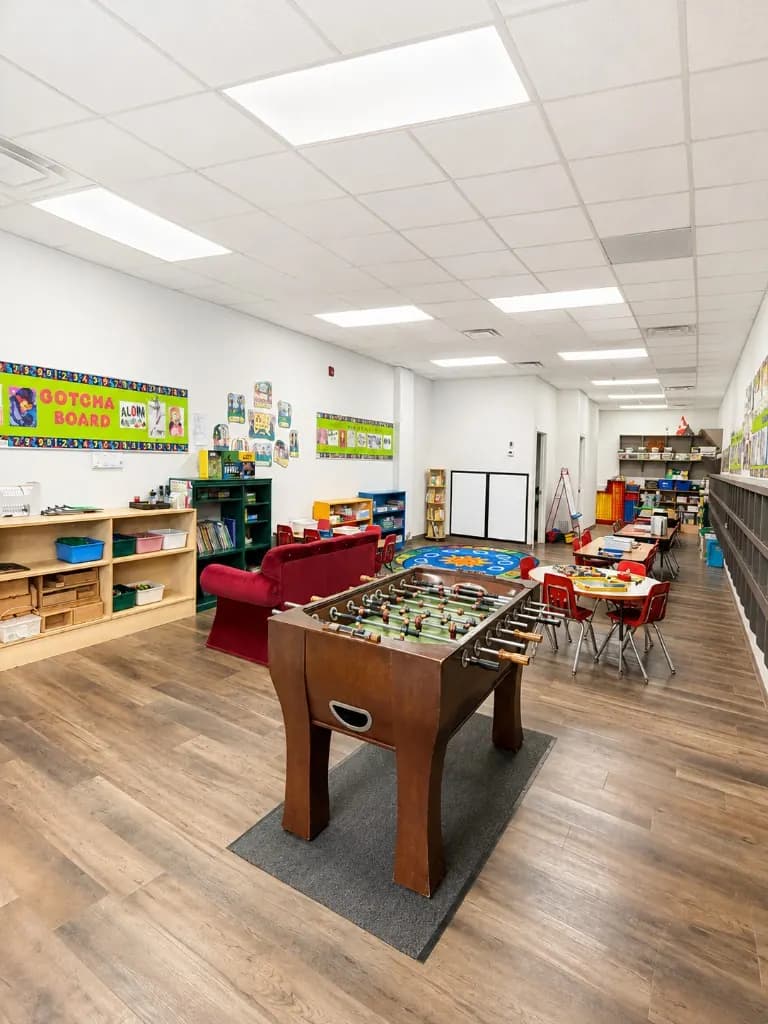
You can see the outdoor space in the centre photos.