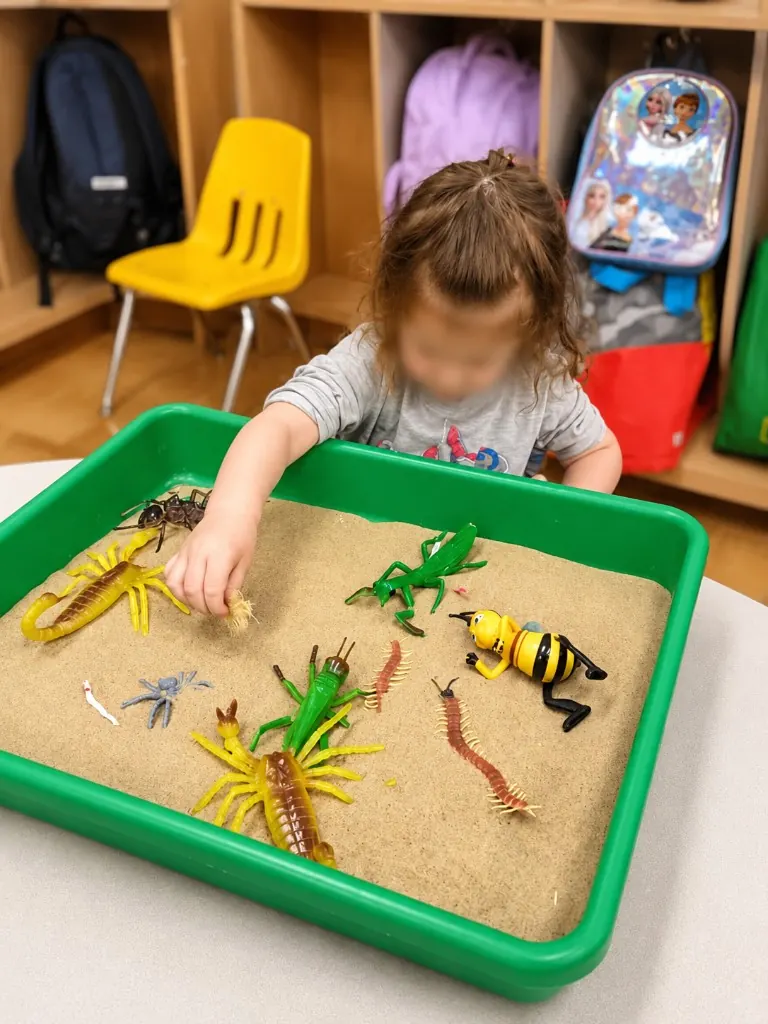
Walk into any of our rooms and you will find, alongside the conventional toys, baskets of things that are not toys at all: corks, bottle caps, wooden offcuts, pine cones, buttons, lengths of ribbon, cardboard tubes, smooth stones.
This is called loose parts play, and it is one of the highest-value, lowest-cost things a room can offer.
The principle
A toy with one function teaches one thing and then is finished. A fire engine is a fire engine. A child plays with it as a fire engine, and after the fourth time they know everything the toy has to say.
A basket of corks is nothing in particular, which means it can be anything. Corks become food, money, people, cargo, fence posts, planets. The child supplies the meaning, and supplying the meaning is the entire cognitive act.
The technical term for this is that loose parts have a high number of affordances — possible uses. The number of affordances is roughly the amount of thinking a material can generate.
What you actually see
Give a group of four-year-olds a tray of mixed loose parts and within twenty minutes you will see sorting, patterning, counting, symbolic substitution, negotiation over scarce items, and elaborate collaborative narrative. Every one of those is a curriculum objective and none of them had to be taught.
You will also see a great deal of quiet, sustained concentration, which is increasingly rare and worth protecting.
Starting a collection at home
It costs nothing. A shallow tray or a shoebox and:
- Bottle caps and jar lids
- Corks
- Large buttons
- Fabric scraps and ribbon offcuts
- Pine cones, smooth stones, sticks, shells
- Cardboard tubes and egg cartons
- Wooden clothes pegs
- Old keys, curtain rings, large nuts and washers
Two rules: keep the pieces large enough not to be a choking hazard for the age of the child using them, and resist the urge to tell them what it is for.
The hardest part for adults
Not intervening. There will be a long pause where nothing appears to be happening, and the instinct is to suggest something. Wait it out. The pause is where the idea forms.
And accept that it will be tipped out, mixed up, and spread across the floor. Tidying it up together at the end is a sorting activity in its own right.
More on how we build the environment in our approach.