A parent told us recently that reading to her two-year-old was pointless because he never lasted past the second page. She had concluded he did not like books.
He likes books very much. He listens to three or four of them a day in his room here. What he does not like is sitting still, which is a completely different problem and a much easier one.
Toddlers do not read the way you were read to
The image most of us carry is a child on a lap, a full story, start to finish, in order. That image comes from a four-year-old.
A two-year-old engages with a book on their own terms, and their terms look like this:
- Turning to the same page eleven times
- Skipping the ending entirely
- Naming things on the page rather than following the story
- Closing the book, walking away, and coming back ninety seconds later
- Insisting on the same book every night for six weeks
Every one of those is real reading behaviour. The last one in particular — repetition is how a toddler moves from hearing words to predicting them, and prediction is the foundation of comprehension.
What actually matters at this age
Not finishing the book. Three things:
- Hearing words they do not hear in normal conversation. Books are where a toddler meets enormous, creaking, underneath, disappointed. Ordinary household speech runs on a surprisingly small vocabulary. Books widen it, and vocabulary at three is one of the better predictors of reading at eight.
- Learning how books work. Front to back, left to right, the pictures relate to the words, the marks on the page mean something fixed. This is called print awareness and it is invisible until it is missing.
- Associating books with somebody's undivided attention. This is the one that lasts. A child who has learned that books mean five warm minutes with a person they love will pick up books for the rest of their life.
None of that requires reaching the last page.
Things that work
- Read while they do something else. Read aloud while they stack blocks. They are listening. Attention in a two-year-old is not the same as eye contact.
- Let them steer. If they want page four again, do page four again. If they want to skip to the digger, skip to the digger.
- Narrate the pictures instead of the text. "Look, he's got mud on his boots. Where do you think he's been?" is often better than the written sentence.
- Read at the calmest point of the day, not bedtime. Bedtime is loaded. Try mid-morning or after lunch, when nobody is negotiating about sleep.
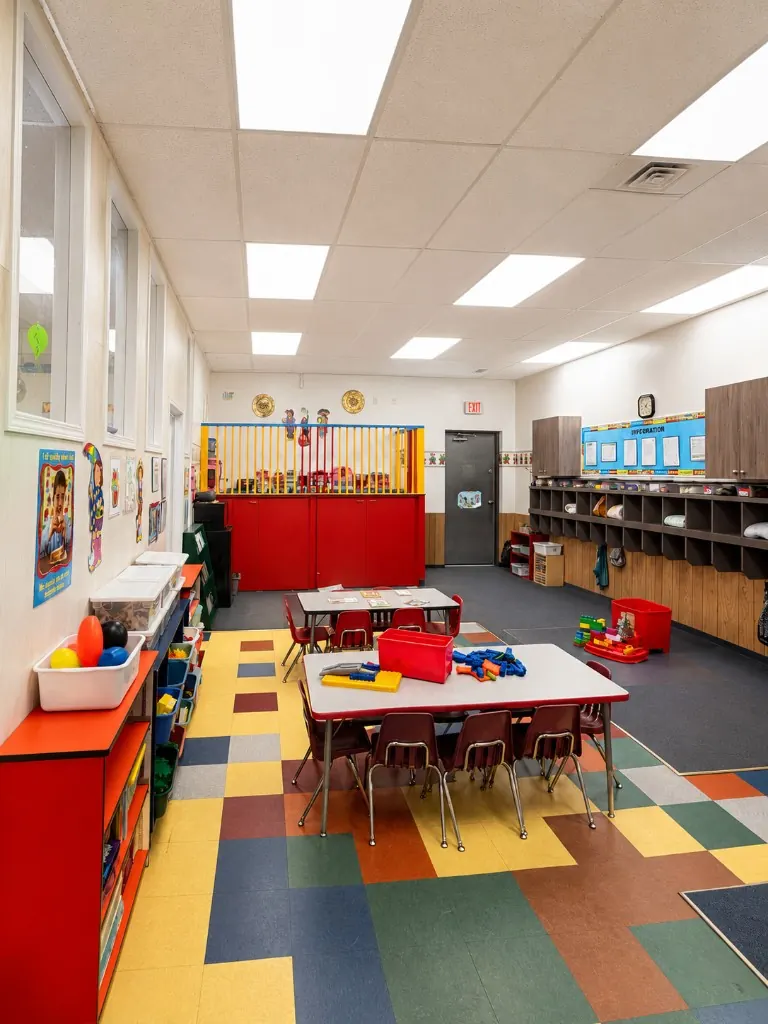
- Keep books at their height. A basket on the floor gets used ten times more than a high shelf. Ours are all at child level for exactly this reason.
- Board books they can wreck. A toddler who is allowed to handle books roughly learns to handle books. Save the beautiful hardback for when they are five.
- Read the same book to the point of your own boredom. Their gain from repetition is real, and your suffering is temporary.
When to actually pay attention
Books are not usually where a real problem shows up first, but a few things are worth mentioning to your doctor:
- No single words by around eighteen months, or no two-word phrases by around two years
- Not pointing at things to show you them by eighteen months
- A clear loss of words or skills they previously had
- No response to their name, or a pattern of not responding to sound
Early language support in Alberta is far more effective at two than at four, and asking is free. Bring it up with us too — educators see a child in a group all day and often have useful context.
The one that surprises people
Talking counts almost as much as reading. Narrating your day, naming the vegetables in the trolley, describing what you are doing while you do it — a child who hears a running commentary on ordinary life gets a large share of the same benefit.
So if books are a battle this month, talk instead. Come back to books in a few weeks. Nothing is lost.
More on how we handle literacy across the day in our approach, or in the Academic Pre-K program for the older children.