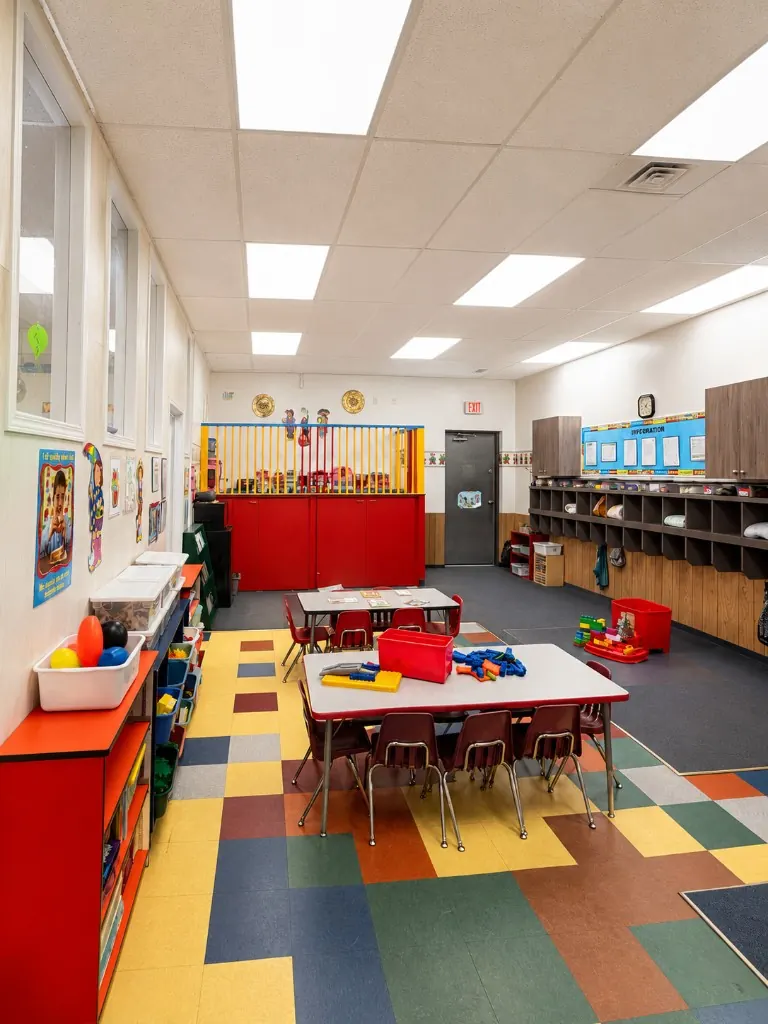
Parents see the two ends of the day and imagine the middle. Here is the middle.
The shape
6:30 – 8:00 · Arrivals. Quiet activities — books, puzzles, drawing at a table. Deliberately low-key. A child arriving at 6:45 does not want a group activity; they want to sit down.
8:00 – 8:45 · Breakfast and free play. Rooms fill. Play gets louder and more social as more children arrive.
8:45 – 9:00 · Tidy and circle. The transition song, then a short group time — the day, the weather, a song, what is happening today.
9:00 – 11:00 · Learning blocks and centres. In the Academic Pre-K group this is the structured literacy, math, and fine motor sequence. In the general preschool room it is activity centres — art, blocks, sensory, house corner, books — with educators moving between them and one small-group focused activity running alongside.
11:00 – 11:30 · Outdoor time. Nearly every day, nearly all weather.
11:30 – 12:15 · Lunch. Handwashing, serving themselves where they can, twenty-five minutes at the table, then tidying their own things.
12:15 – 12:30 · Toileting and settling. Cots out, lights down, the same music every day.
12:30 – 2:30 · Rest. Sleep for those who need it, quiet time with books for those who do not. Nobody is made to sleep.
2:30 – 3:00 · Waking and snack. Gradual. Children wake at different rates and the room stays quiet for the ones still going.
3:00 – 4:00 · Second outdoor block, or indoor gross motor if the weather has closed in.
4:00 – 5:00 · Free play and small groups. Often the best play of the day — long, elaborate, and child-directed, because there is nothing scheduled to interrupt it.
5:00 – 6:00 · Departures. Calm activities, tidying, and the daily handover conversation at the door.
Why the times barely move
Because predictability is what frees a child's attention for everything else. The frame stays fixed; the content inside it changes constantly.
Where the flexibility is
If a group is deep in something extraordinary at 10:50, we do not stop it for outdoor time. If a room is falling apart at 10:15, we go outside early. The schedule serves the room, not the reverse.