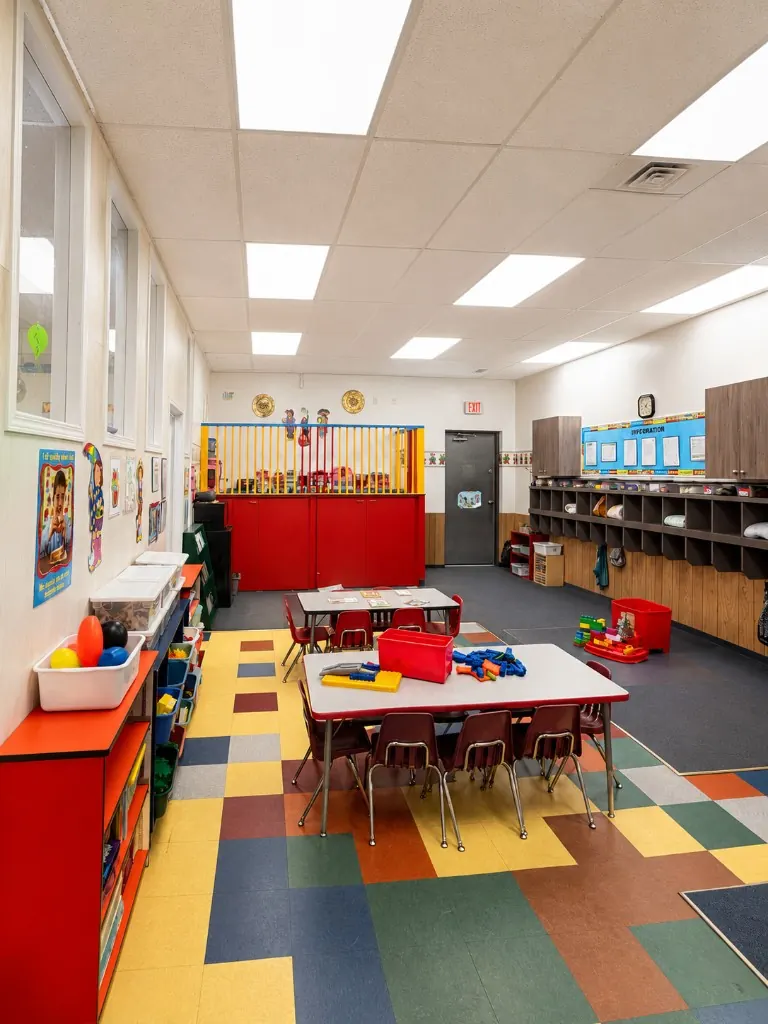
The block area is where the mathematics happens, and almost nobody labels it that way.
What a child is actually doing
A four-year-old building a tower is working with:
- Balance and centre of gravity. Learned by failing, repeatedly, and adjusting.
- Equivalence. Discovering that two short blocks equal one long one is a fraction concept, arrived at physically.
- Symmetry. Children start producing symmetrical structures spontaneously around four, unprompted.
- Measurement and comparison. Taller, wider, longer, the same.
- Spatial reasoning. Mentally rotating a shape to see whether it will fit. This one is strongly associated with later mathematics achievement.
- Planning. Older children build to an intention rather than piece by piece, and revise when it fails.
The research point worth knowing
The sophistication of a child's block construction in preschool has been found to relate to mathematics achievement years later. Not because blocks teach arithmetic, but because they build the spatial and structural intuitions that arithmetic later sits on.
Which is a good argument for a large set of blocks and a lot of uninterrupted floor time.
What makes a block area work
Enough blocks. The most common failing. A handful limits everything; a large set enables real structures.
Plain wooden unit blocks, in proportional sizes, so that two of one equal one of another. That proportion is where the mathematics lives.
Floor space, protected. A structure that gets knocked by passing traffic will not be attempted again.
Time, and permission to leave it up. The best building happens on day two of a structure. Where we can, we leave things standing overnight.
Props to extend it — small animals, vehicles, people, fabric. These turn a structure into a narrative and keep children there far longer.
What an adult should say
Mostly: describe rather than praise. "You put the long ones at the bottom this time" tells a child you noticed their thinking. "Good job" tells them nothing.
And ask the occasional genuine question. "What will you do about that gap?" — then wait.